
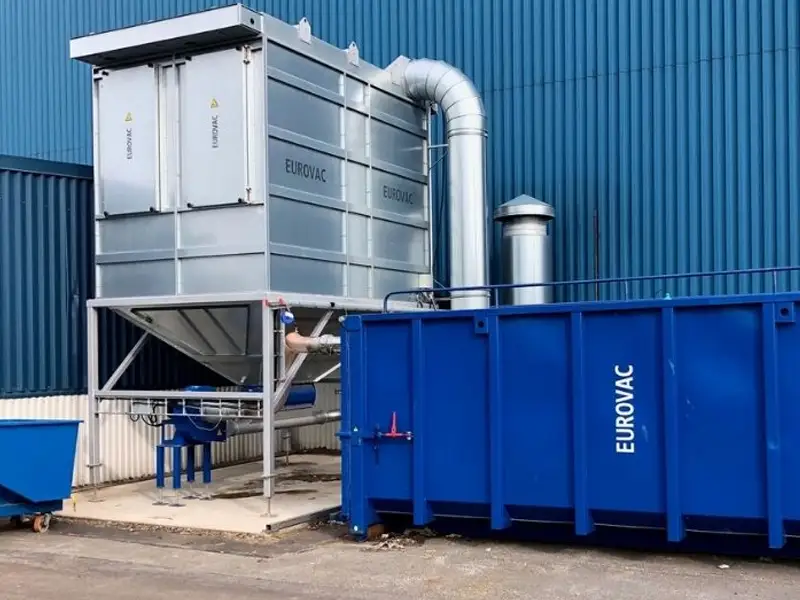
Dust and sawdust removal systems

We design Eurovac dust and debris removal systems in collaboration with our customers.

Extensive in-house manufacturing and long-term European suppliers guarantee the high quality of Eurovac debris and dust extraction systems.

We manufacture systems for industries such as:

Wood industry

Plastic industry

School places

Power plants

Metal industry

Paper industry

Concrete industry

Process industry

Food industry

Things to consider in planning

  • What does the system remove? Dust or debris?

  • What material?

  • Amount of dust and debris to be removed e.g. cubic metres per day

  • Number of simultaneous machine tools in use and their removal units

  • Where you want to collect the dust/debris (e.g. container, tipper, or swap body)

  • Piping material? E.g. galvanised steel, RST or HST

Dust collectors and debris extractors are supplied with cartridge filters and hose filters, as well as different types of dust collectors.

If necessary, our professional representative will visit the site to assess the situation, and we will map the equipment required, its location, power requirements and the possible location of the demolition and dust extraction piping.

We have extensive experience in implementing school systems

We provide domestically manufactured, customer-focused solutions for educational institutions, including sawdust extraction systems, textile dust extraction systems, multi-purpose dust extraction systems, and other localized extraction systems and fans

Get in touch, and let’s work together to find the best solution for you!

Filter units with hose filters

A tailored solution for demanding dust removal needs

Eurovac PP filter units

Designed and manufactured in Finland, the structure can withstand demanding use. Automatic compressed air cleaning ensures consistent performance. Modularity allows precise sizing for different applications - from silos to conveyors and screening plants.

Available in two basic designs: open-bottom model and model with a bottom cone and suction connection.

Equipment options

  • Materials: stainless steel (RST) or galvanised steel
  • Insulation: thermal insulation and, if necessary, a defrosting cable
  • Blower: with or without housing; positioned on the side of the unit or separate, connected by a pipe
  • Channels: recommendation for a longitudinally stable transport channel

Unpacking methods

  • Open bottom - dust returns directly to the space below the filter
  • Dust bin: size to be determined according to need
  • With trap feeder to the space below the appliance or e.g. in a large bag

Performance values

  • Filters: 20-164 pcs
  • Filter surface area: 13-128 m²
  • Capacity: approx. 1 000-30 000 m³/h
  • Compressed air requirement: 6-8 bar
  • Filter cleaning: automatic

More detailed model-specific information can be found in the PP filter units brochure.
Our system sales representatives will be happy to help you select and dimension the right system for your needs.

Industrial dust removal

Eurovac JCX and JEX hose filter units

Product number:087806

The units can be equipped with various dust containers, rotary valves, and big-bag stands. Filter bag replacement is possible either through a service door or from the top. Also available with ATEX classification. Airflow rates: 350 – 47,500 m³/h. Filter surface areas: 10 – 190 m².

The device can also be placed outdoors. Applications in industries such as chemistry, feed, wood, aggregates, food and waste treatment.

For versatile dust removal and separation of clippings

Filter unit Eurofilter

Product number:087805

Eurofilter models are designed for a wide range of industrial dust removal applications. They are designed to be easy to use, reliable and durable. Eurofilter dust collectors are suitable for separating different types of dust and dry cuttings from one or more dust collection points.

The Eurofilter unit is a galvanised steel panel unit with sock filters and automatic filter cleaning with compressed air. Dust is collected in metal wheeled bins or discharged from the dust chamber by means of a barrier feeder (compressed air requirement for filter cleaning 6-8 bar/300l/min).

Contact us and we'll tell you more.

Compact and efficient solution for smaller spaces

Vacumobil

Product code: vacumobil

Vacumobil dust extraction units are suitable for a wide range of dust extraction applications. Thanks to their compact design, they require little space. The units can be equipped with vibration or compressed air cleaning. Depending on the site, either a dust container or a barrier feeder is selected for the unit. A briquette press is also available as an option.

For more information:

  • Blower power 2,2 - 11 kW
  • Air volumes 1100 - 8600 m³/h
  • Filter surface areas 7 - 35 m²
  • Maximum sound pressure level 75 dB(A)

Filter units with cartridges

Cartridge filter units are designed for fine and dry dust. The filter area and material are selected according to the dust to be sucked and the required air volume. Cartridge filters generally have a high air volume but a lower dust volume. Units are manufactured for air volumes up to 350 000 m³/h.

Filter cleaning is automatically timed or based on pressure differential by means of a compressed air jet. We have a wide range of cartridge filter units that can be tailored to the customer's needs. Dust can be collected in a container of the customer's choice or returned to circulation. The container can be a tank, a tipper, a large sack or even a waste container. The dust can also be transferred to the container by means of a screw or dropped directly onto a conveyor.

For high air volumes and fine dust filtration

Cartridge filter units

Product number: 087521

Filter unit with cartridge filter. Suitable for small amounts of dust and air, for example in connection with grinding machines and small machine tools. Also suitable as a filter unit for central grinding machines if the pressure is below 350 mbar. Can also be equipped with a trap feeder for discharge into a garbage chute or large bag.

The unit is also used for filtering welding gases. Filters are selected as required

For more information:

  • air flow min/max: 750/1500 m³/h
  • filter area paper/polyester: 40/14 m²
  • cartridges 1 piece
  • waste bin 50 l, also other options
  • vacuum resistance: 35000 Pa
  • dimensions approx. height*width*depth: 1880 x 600 x 730 mm
  • joints d. 158,5 mm
  • weight: 350 Kg
  • pressure-air requirement: 0,75-0,20m3/min and 5 bar

Product number: 087512

Filter unit with cartridge filters. Cleaning of the filters by means of a compressed air jet at adjustable intervals or based on the pressure difference. Suitable for filtration of various flue gases in different industrial processes. Standard with 50 litre dust tank. Filters selectable according to requirements.

For more information:

  • air flow min/max: 1500/3000 m3/h
  • filter area paper/polyester: 80/36 m2
  • cartridges 2 pieces
  • waste bin 50 l, also other options
  • vacuum resistance: 30000 Pa
  • dimensions approx. height*width*depth: 2450*880*1160 mm
  • joints d. mm 250
  • weight: 400 Kg
  • pressure-air demand: Nm3/min /bar 0,05-0,15/5

Product number: 087502

Filter unit with cartridge filters. Cleaning of the filters by means of a compressed air jet at adjustable intervals or based on the pressure difference. Suitable for filtration of various flue gases in different industrial processes. Standard with 50 litre dust tank. Filters selectable according to requirements

For more information:

  • air flow min/max: 2000/6000 m3/h
  • filter area paper/polyester: 80/36 m2
  • cartridges 4 pieces
  • waste bin 50 l, also other options
  • vacuum resistance: 30000 Pa
  • dimensions approx. height*diameter: 2620*1250 mm
  • joints d. mm 400
  • weight: 550 Kg
  • pressure-air demand: Nm3/min /bar 0,1-0,25/5

Product number: 087531

A cartridge filter unit with a specially designed gravity fed dusty air inlet. In addition, the unit has built-in baffles that protect the cartridges from wear and evenly distribute the air to the filter. The filter is equipped with an efficient filter cleaning system based on compressed air blasting. If the dust load is high, it is recommended to use a polyester filter instead of a paper filter.

There are several models depending on the filter surface area, up to 350.000 m3 air volume. The unit can be equipped with a dust container or a shut-off feeder.

For more information:

  • Air flow min/max: 6000/350000 m3
  • Filter area 144 - 2900 m2
  • Cartridges 12 - 240 pieces
  • Bin 50 l, also other options
  • vacuum resistance 3000 - 4000 Pa

Product number: 087506

Filter unit with cartridge filters. Cleaning of the filters by means of a compressed air jet at adjustable intervals or based on the pressure difference. Suitable for filtration of various flue gases in different industrial processes. Standard with 50 litre dust tank. Filters selectable according to requirements.

For more information:

  • air flow min/max: 2500/10000 m3/h
  • filter area paper/polyester: 212/96 m2
  • Cartridges 4 pieces
  • waste bin 50 l, also other options
  • vacuum resistance: 30000 Pa
  • dimensions approx. height*diameter: 3150*14000 mm
  • joints d. mm 400
  • weight: 5600 Kg
  • pressure-air demand: Nm3/min /bar 0,1-0,25/5

Cyclones

Eurovac cyclones are mainly used as pre-separators to enhance the performance of the main filters and to filter large particles, dust, chips and shavings.

Eurovac cyclones are manufactured according to customer needs

  • based on custom needs
  • can also be made of RST and wear-resistant steel
  • also with different concentrations
  • can be equipped with a tank or a shut-off feeder
  • with mounting feet or the necessary mounting bracket
  • colour shade selectable
  • pipe connections as required
  • fast deliveries

Eurovac Cyclones
An efficient pre-separator for industrial dust removal

Eurovac cyclones

Product No: 214100

Eurovac cyclones are designed for the efficient separation of industrial dust, sawdust, wood chips, and other particles from the air stream. A cyclone typically functions as a pre-separator before the main filtration system or as part of a more comprehensive dust removal solution.

Eurovac cyclones are always designed and manufactured to meet the specific requirements of the application. Factors taken into account during the design process include air volume, the properties of the material being conveyed, particle size, and process requirements.

How does a cyclone work?
A cyclone operates on the principle of centrifugal force. Dust-laden air is fed into the cyclone from the side, causing the airflow to spin rapidly inside the device. The rotating motion separates the heavier particles from the air stream, after which the material settles at the bottom of the cyclone and the cleaned air exits through the top.

As a result, the cyclone reduces the load on the main filtration system and improves the overall performance of the system.

Applications
Eurovac cyclones are suitable for a wide range of industrial applications where dust, sawdust, shavings, or other particles need to be separated from the air stream. Typical applications include, for example:

  • wood processing industry
  • the sawmill and woodworking industry
  • metal industry
  • recycling industry
  • process industry
  • material handling

Customized solutions tailored to your application
Eurovac cyclones are always designed to meet the specific requirements of the application and process. The design takes into account, among other things:

  • airflow rate
  • type of material to be separated
  • particle size and material weight
  • amount of dust in the process
  • Installation space and system architecture
  • the right collection solution

Standard-size Eurovac cyclones are available in sizes ranging from Eurovac 30 to 220 (Ø300–Ø2200 mm), with a capacity range of approximately 600–45,000 m³/h.

If necessary, we also manufacture cyclones that are not part of our standard product range and are customized to meet the customer’s specific needs.

Material Options and Specifications
Eurovac cyclones can be manufactured from various materials depending on the application, such as:

  • made of black steel
  • made of carbon steel
  • stainless steel
  • made of acid-resistant steel

Cyclones can also be equipped according to the application, for example:

  • with a tank
  • through a bulk bag collection
  • with a shut-off valve
  • using various mounting brackets
  • with pipe fittings designed for the specific application

Advantages of the Eurovac cyclone

  • High-efficiency pre-filter for industrial dust removal
  • reduce the load on the filters
  • long service life
  • low maintenance requirements; can be customized to suit the application

For more information, contact
We can help you select and size the right cyclone solution for your specific application.

Contact us, and we’ll design a Eurovac cyclone that fits your process.

Erosion separation with a convenient removable tank

Cyclone with 200 L tank

Product number: 090301

The cyclone is mounted on top of a 200l tank, acting as a pre-separator to remove work loads and dust. The unit can be installed in the discharge/dust piping before the filter and blower equipment. The unit is equipped with a wall/lifting bracket so that the cyclone can be gently lifted off the top of the debris tank by means of a lever arm, allowing the debris tank to be easily removed for emptying.

The cyclone has standard 160 mm suction connections, which can be reduced to the desired pipe/pipe size if required. The cyclone is rated to operate efficiently from 1300 to 4700 m³/h and can withstand a pressure of 35000 Pa (350 mbar).

Pipelines and accessories

Dust and debris removal pipelines

Product number: 047700

We have a great selection of pipeline parts and accessories. We manufacture vacuum tables, hoods and exhaust walls to meet custom demands.

Ask more.

Inquiries about dust and chip removal systems

A system designed for metal dust, grinding, cutting, and other similar processes is suitable for the metal industry. The solution takes into account the amount of dust, particle size, potential spark hazards, and, if necessary, ATEX requirements. Often, the best results are achieved with a system tailored to the specific application.
The best solution for the woodworking industry is usually a dust extraction system sized according to the facility’s machinery and airflow rates. It is important that the system be capable of safely and energy-efficiently removing both coarse sawdust and fine wood dust. When designing the solution, ATEX and fire safety requirements are also taken into account.
Electricity consumption depends on the power of the fan or suction unit, the operating time, and the pressure drop. Smaller units consume significantly less energy than large industrial systems, where air volumes and pressures are high. Exact consumption is always estimated based on the selected unit’s power and operating hours. The system’s power—and thus its electricity consumption—is always optimized during design to suit the specific application. Savings can also be achieved by adjusting the system’s power in real time according to operational needs.
Removing welding fumes requires a solution designed specifically for fumes and vapors, not just a standard dust collection system. Welding fumes contain extremely fine particles and gases, so the system’s filtration and ventilation must be specifically designed for this purpose.
The correct size is selected based on the number of machines, the airflow they require, simultaneous use, and the scale of production. Additionally, the length of the ductwork, the layout of the space, and any potential future expansion needs are taken into account. A unit that is too small will not remove dust effectively, and a unit that is too large can be unnecessarily expensive and consume excessive amounts of energy.
The sizing is based on the equipment manufacturer’s recommendations, the source of the dust, the ductwork design, and the number of machines that may be in operation at the same time. The right combination of airflow and pressure determines whether dust can be collected efficiently. Precise sizing is always done on a case-by-case basis, not based on general figures alone.
Recirculation of filtered air may be possible if the filtration is adequate and the dust characteristics allow it. The filter materials and classes used are selected based on the type of dust. Fine dust or dust that is harmful to health may require more effective post-filtration, whereas basic filtration is often sufficient for coarser dust. The solution must always be evaluated based on the specific application.
The noise level depends on the fan, filter, airflow, and location. Noise is controlled through the use of silencers, insulation, proper placement, and, if necessary, a separate machine room. For solutions used near workstations, noise control should be taken into account as early as the design phase.
The replacement interval depends on the amount and type of dust, as well as the duration of use. Automatic compressed air cleaning helps keep the filter cleaner and extends its service life, but generally requires a sufficient supply of clean compressed air. In practice, the condition of the filters is monitored regularly, and they are replaced when cleaning is no longer sufficient or the pressure drop across the filter increases too much. This is indicated by a decrease in suction power.
Suomen Imurikeskus provides maintenance, spare parts, and technical support for Eurovac equipment. It is advisable to review the terms of the maintenance contract, the availability of remote support, and typical maintenance intervals based on the specific equipment and its intended use during the quotation or delivery phase.
Delivery time and installation duration depend on the size of the project, the scope of the equipment to be manufactured, and the installation conditions. Typically, a project proceeds from the initial assessment through design, manufacturing, installation, user training, and handover. A more detailed schedule will be provided with the quote.
A local dust extraction unit is suitable for a single workstation or machine. A central vacuum system serves multiple workstations and is a good solution for large facilities. A heavy-duty industrial vacuum cleaner, on the other hand, is suitable for mobile use, heavy-duty cleaning, and vacuuming challenging materials without the need for fixed ductwork. The choice depends on the intended use, the materials involved, and the size of the cleaning area.
The energy efficiency of these systems depends on proper sizing, effective filtration, the selection of an appropriate fan, the use of air recirculation where possible, and the ability to adjust the equipment during operation. Significant environmental benefits include efficient dust collection, a cleaner work environment, and the ability to better control material flows. However, energy efficiency must be assessed on a system-by-system and site-by-site basis.