
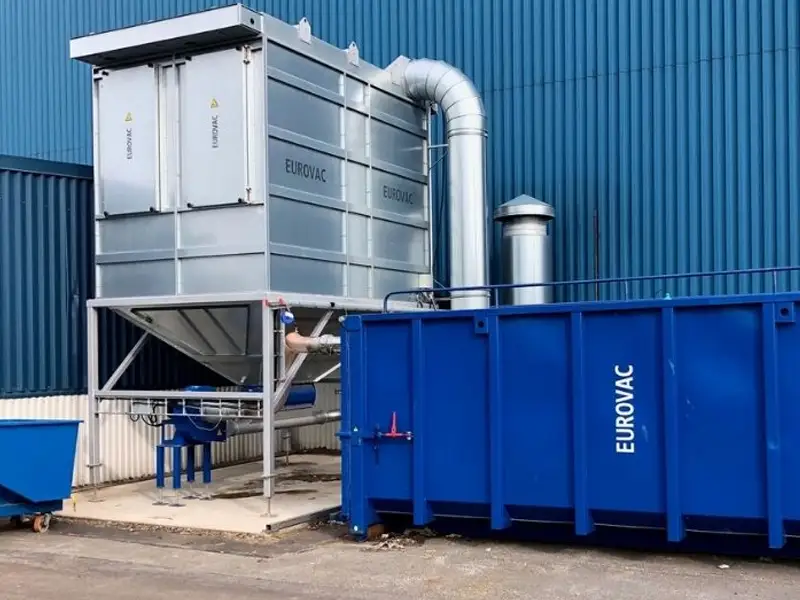
Dust and sawdust removal systems

We design Eurovac dust and debris removal systems in collaboration with our customers.

Extensive in-house manufacturing and long-term European suppliers guarantee the high quality of Eurovac debris and dust extraction systems.

Learn about different types of chip and dust extraction systems

Filter units with hose filters

For removing dust, sawdust, and dry cutting debris.

Filter units with cartridges

For filtering fine, dry dust.

Cyclones

For the preliminary separation of dust, sawdust, and wood shavings before the main filter.

Pipelines and accessories

Piping components and accessories for dust and chip extraction systems.

Has the suction power of your current dust extraction system
decreased?

One of the most common causes of poor suction performance or clogged systems is a dust extraction duct system that has been improperly designed and installed.

Experts at Suomen Imurikeskus Oy frequently encounter sites where dust extraction systems have been built using standard HVAC components. This results in additional costs and significant safety risks.

If the system is installed using a thinner-than-usual spiral-seam duct with standard corner pieces, several problems will arise right from the start:

  • Suction power is lost along the way
    Incorrect connections, excessively sharp branch points (e.g., straight 90-degree T-branches), and corrugated pipe bends cause severe turbulence and flow disturbances. Suction power is lost before it even reaches the actual dust extraction point.
  • Blockages
    When chips, sawdust, or heavy dust pass through the pipe, power losses caused by faulty components cause the material to accumulate in the bends of the piping and eventually lead to a blockage of the entire system.

  • Pipe Wear
    Heavy material traveling at high speeds quickly wears through inexpensive HVAC pipes.

Read more on our blog:

Benefits of a Dust Removal System

Accurate flow calculations ensure effective extraction and a clean work environment

When piping components and branches are selected based solely on dust removal requirements, the airflow maintains sufficient velocity and material does not accumulate in the bends of the pipe.

01

High-Efficiency Flow

Right angles and Y-branches prevent turbulence and ensure that suction power reaches all the way to the end.

02

No unnecessary equipment purchases

Careful optimization of the ductwork often allows you to keep your existing vacuum cleaner without having to replace it at great expense.

03

Long service life

These wear-resistant specialty pipes are designed to withstand even the most severe stress caused by sawdust and dust.

We manufacture dust and chip extraction systems for the following industries, among others:

Wood industry

Plastic industry

School places

Power plants

Metal industry

Paper industry

Concrete industry

Process industry

Food industry

We have extensive experience in implementing school systems

We provide domestically manufactured, customer-focused solutions for educational institutions, including sawdust extraction systems, textile dust extraction systems, multi-purpose dust extraction systems, and other localized extraction systems and fans

Get in touch, and let’s work together to find the best solution for you!

We'll design a system that's just right for you

Things to consider in planning

  • What does the system remove? Dust or debris?

  • What material?

  • Amount of dust and debris to be removed e.g. cubic metres per day

  • Number of simultaneous machine tools in use and their removal units

  • Where you want to collect the dust/debris (e.g. container, tipper, or swap body)

  • Piping material? E.g. galvanised steel, RST or HST

Dust collectors and debris extractors are supplied with cartridge filters and hose filters, as well as different types of dust collectors.

If necessary, our professional representative will visit the site to assess the situation, and we will map the equipment required, its location, power requirements and the possible location of the demolition and dust extraction piping.

Inquiries about dust and chip removal systems

A system designed for metal dust, grinding, cutting, and other similar processes is suitable for the metal industry. The solution takes into account the amount of dust, particle size, potential spark hazards, and, if necessary, ATEX requirements. Often, the best results are achieved with a system tailored to the specific application.
The best solution for the woodworking industry is usually a dust extraction system sized according to the facility’s machinery and airflow rates. It is important that the system be capable of safely and energy-efficiently removing both coarse sawdust and fine wood dust. When designing the solution, ATEX and fire safety requirements are also taken into account.
Electricity consumption depends on the power of the fan or suction unit, the operating time, and the pressure drop. Smaller units consume significantly less energy than large industrial systems, where air volumes and pressures are high. Exact consumption is always estimated based on the selected unit’s power and operating hours. The system’s power—and thus its electricity consumption—is always optimized during design to suit the specific application. Savings can also be achieved by adjusting the system’s power in real time according to operational needs.
Removing welding fumes requires a solution designed specifically for fumes and vapors, not just a standard dust collection system. Welding fumes contain extremely fine particles and gases, so the system’s filtration and ventilation must be specifically designed for this purpose.
The correct size is selected based on the number of machines, the airflow they require, simultaneous use, and the scale of production. Additionally, the length of the ductwork, the layout of the space, and any potential future expansion needs are taken into account. A unit that is too small will not remove dust effectively, and a unit that is too large can be unnecessarily expensive and consume excessive amounts of energy.
The sizing is based on the equipment manufacturer’s recommendations, the source of the dust, the ductwork design, and the number of machines that may be in operation at the same time. The right combination of airflow and pressure determines whether dust can be collected efficiently. Precise sizing is always done on a case-by-case basis, not based on general figures alone.
Recirculation of filtered air may be possible if the filtration is adequate and the dust characteristics allow it. The filter materials and classes used are selected based on the type of dust. Fine dust or dust that is harmful to health may require more effective post-filtration, whereas basic filtration is often sufficient for coarser dust. The solution must always be evaluated based on the specific application.
The noise level depends on the fan, filter, airflow, and location. Noise is controlled through the use of silencers, insulation, proper placement, and, if necessary, a separate machine room. For solutions used near workstations, noise control should be taken into account as early as the design phase.
The replacement interval depends on the amount and type of dust, as well as the duration of use. Automatic compressed air cleaning helps keep the filter cleaner and extends its service life, but generally requires a sufficient supply of clean compressed air. In practice, the condition of the filters is monitored regularly, and they are replaced when cleaning is no longer sufficient or the pressure drop across the filter increases too much. This is indicated by a decrease in suction power.
Suomen Imurikeskus provides maintenance, spare parts, and technical support for Eurovac equipment. It is advisable to review the terms of the maintenance contract, the availability of remote support, and typical maintenance intervals based on the specific equipment and its intended use during the quotation or delivery phase.
Delivery time and installation duration depend on the size of the project, the scope of the equipment to be manufactured, and the installation conditions. Typically, a project proceeds from the initial assessment through design, manufacturing, installation, user training, and handover. A more detailed schedule will be provided with the quote.
A local dust extraction unit is suitable for a single workstation or machine. A central vacuum system serves multiple workstations and is a good solution for large facilities. A heavy-duty industrial vacuum cleaner, on the other hand, is suitable for mobile use, heavy-duty cleaning, and vacuuming challenging materials without the need for fixed ductwork. The choice depends on the intended use, the materials involved, and the size of the cleaning area.
The energy efficiency of these systems depends on proper sizing, effective filtration, the selection of an appropriate fan, the use of air recirculation where possible, and the ability to adjust the equipment during operation. Significant environmental benefits include efficient dust collection, a cleaner work environment, and the ability to better control material flows. However, energy efficiency must be assessed on a system-by-system and site-by-site basis.